I began this blog in 2011, when much of my time, energy and effort was focused on self-managing my own health, and finding a new path ahead of me having become unwell and stopping my studies as a medical student.
Over the years I found writing this to be a really valuable tool to reflect and make sense of experiences I was having, both as a patient, and lately as a 'patient leader', and connecting with a wider community of wonderful people. The support I gained and the communities and opportunities that opened up to me have been instrumental in my own recovery and emerging identity and directions for the future.
In February 2020, I just started a two-year MSc to study and qualify as an Occupational Therapist. I feel very fortunate to be able to fill my days with the occupations of studying and learning on a professional course!
Some of the early reading I have been doing for my Occupational Therapy course have covered the concepts of doing, being, becoming and belonging (Hitch et al, 2014 - referenced in RCOT 2019 Learning & Development Standards). I can see how the occupations I have engaged in as someone living with health conditions were about 'doing' and 'being', but cumulatively have afforded me privileges to enable me to 'become' and 'belong'. At my worst, my days were skewed towards the overwhelming self-care tasks, leaving little time and a perceived lack of capacity (energy or ability) for any leisure or productivity occupation. With support, knowledge and confidence, I've been able to remove some of the barriers to those leisure and productivity activities, while maintaining a (reducing burden) of self-care tasks.
In her paper, Reflection in Professional Development (2013), Spalding notes the value of exploring the theoretical evidence to justify (or otherwise) our actions. Taking this approach, and reflecting on blogging as an occupation, I found a few papers (that although condition specific, so I have extrapolated their conclusions) which gave some reasons I could relate to about why patients choose to blog about their experiences (Hu, 2019 and Gualtieri et al 2013).
From the perspective of the person blogging, I have experienced the 'therapeutic benefit' of blogging and hope/know that some of these blogs have added value to those reading them as professionals to gain insight into patient perspectives. Building on the benefits of reading patient blogs for the wider community of healthcare professionals, I often give medical students reading lists after my lectures - of texts (most often blogs) written by patients, to give them insight into the conditions they are studying that aren't covered within the text books. For this reason, among others, I don't plan to 'delete' my blog. I plan to find a patient blog to complement the academic reading of each module of my course to ensure my learning remains grounded in the people who we work with.
Whilst self-managing is still an occupation I do each day, it is not the 'headline' of my days as it used to be. The experiences and writings from 2011 to 2017 as documented within this blog will always be a part of me, and the lens through which I see things. Whilst 'patient' or 'patient leader' are no longer the opening to my CV, they are nonetheless an intrinsic part of my personal and professional identity. As I add more tools to my toolbox through my academic and vocational learning, my formative experiences through those years will be the metaphorical oil that helps me think about how to use the other tools (assessments, therapeutic approaches and techniques) in my toolbox most effectively with the people I work with.
The sense of a need to post something to somehow update this blog has been with me for a few months since getting a place on the MSc course. I have also been all too aware that I haven't blogged here since 2017, when I started as Patient Editor at the British Medical Journal (BMJ) and had the opportunity to channel more of my writings through their BMJOpinion platform and editorials. It was a lecture on social media and its professional use and benefits that promoted me to write this, as I wanted to create clarity to give this blog context as time passes.
This blog, and the experiences it represents, are remain valid, in the sense that they are an honest representation of how I felt at the time. Because of it's context in that time and place, reading back, there isn't anything I would change, but I am aware as I deepen my knowledge and experiences about occupational therapy as a professional, I may feel differently about some aspects. The management of different conditions and circumstances will evolve as our profession evolves, while the experiences that people with health conditions have is framed within the context of the time and situation (both personally and socially) through which it was lived.
I hope that this blog remains of value for those who find it!
Saturday, 22 February 2020
Tuesday, 10 October 2017
Self-Management Support - another misconception...
I recently heard this when telling a clinician that my interest was in self-management...
I couldn't disagree with this statement in principle (there are people at both ends of the self-management spectrum), but when shared as an argument not to engage in supporting self-management (as it was used), it couldn't be more floored.
Lets break this down...
"The trouble is that there are those patients who do it all already anyway and then those patients who just never will..."
I couldn't disagree with this statement in principle (there are people at both ends of the self-management spectrum), but when shared as an argument not to engage in supporting self-management (as it was used), it couldn't be more floored.
Lets break this down...
Saturday, 8 July 2017
Co-delivered #meded with technology - a joint blog with @TrevorKet
There is a drive in healthcare
education to use technology and involve patients and service users in teaching
sessions. Combining these two important agendas, I collaborated with a
healthcare sciences lecturer, Trevor Kettle (@TrevorKet). to co-deliver two teaching
sessions using the Meetoo app (and Skype). This a blog of two halves, with my reflections and Trevor's reflections (so do make sure you read both bits!)
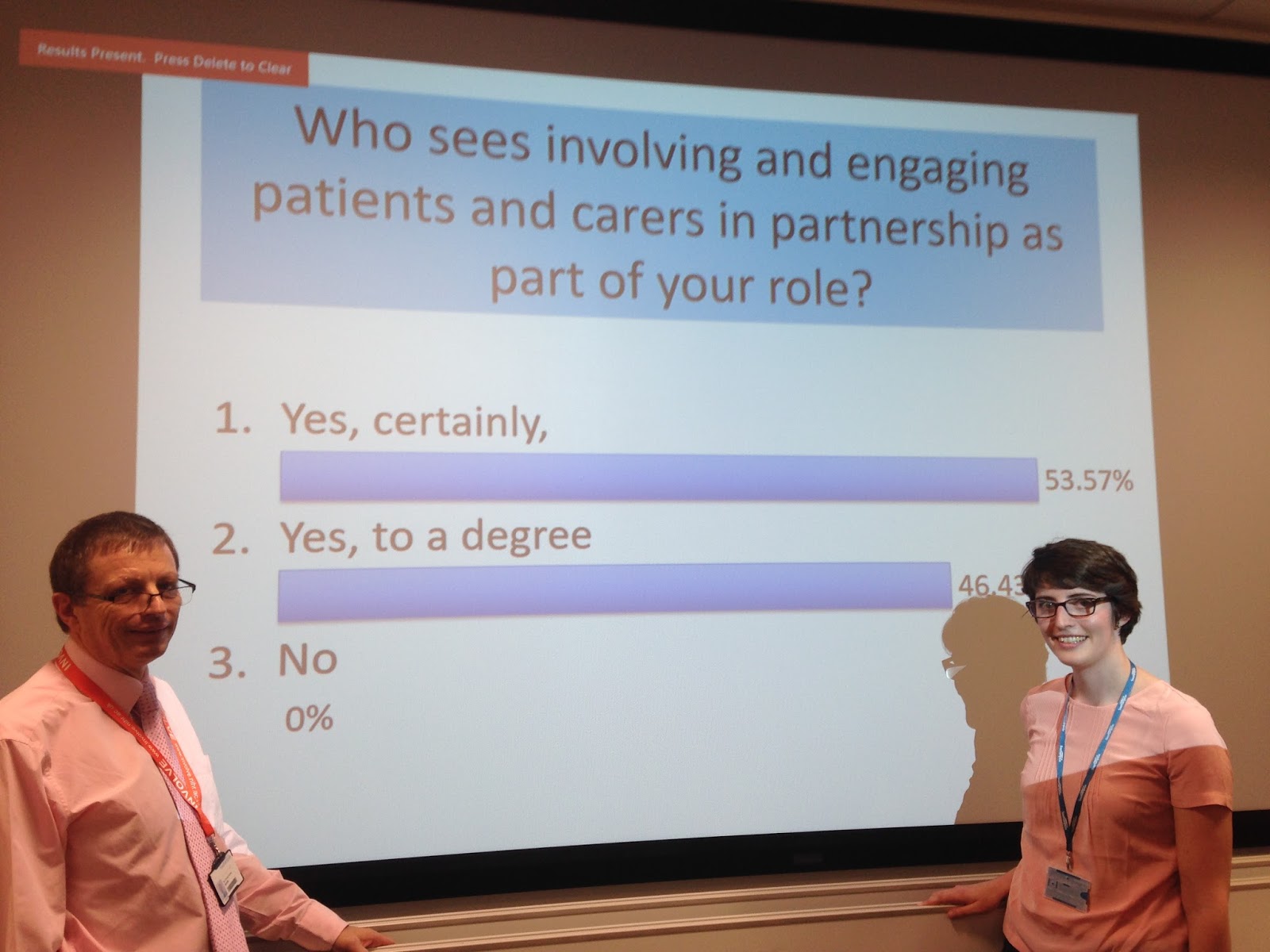
 These were students on two
different courses at the Faculty of Health Sciences at Southampton University –
both post-graduate, qualified health and social care professionals. The
sessions were both 1.5 hours, and the first was co-delivered in person, while
the second was co-delivered with Trevor Kettle in the room, and me Skyping
in.
The Meetoo App is a platform for real-time polling and
discussion that allows students to share their thoughts and reflections,
opinions and ask questions.
This blog is a collection of
reflections on these experiences. These are twofold:
- the process of using technology and
collaborative teaching as a process to educate
- the content of the conversation we had with
the students.
Underpinning all of this was a
strong equal partnership to co-produce the teaching sessions, the content and
process between Trevor Kettle and myself – for which I am very grateful. Far
from being onerous, this collaboration to coproduce the two teaching sessions
required only a preliminary Skype meeting of about an hour and one or two
iterations of the PowerPoint slides being shared via email. We had a short
reflective debrief afterwards. Trevor’s perspective on it all in included
below...
Sunday, 11 June 2017
Learning from Dorset CCG for the STPs
Despite all my complaints as a
teenager to the contrary, Dorset is quite forward thinking, and it has
demonstrated this in its approach to transformation in the local NHS. In
mid-2014, the Dorset Clinical Commissioning Group (CCG) decided to take
pre-emptive action to maintain health and wellbeing, quality services and to
avoid a looming gap in local NHS finances and began a Clinical Services Review
(CSR). With the aim of supporting people in Dorset to lead healthier lives, Dorset
CCG recognized that significant, meaningful and effective engagement and
involvement with local people who use services was essential. As with any
project on this scale, engagement and involvement needs to be multifaceted. I
was most involved in one these facets, as Chair of the Patient, (Carer) and
Public Engagement Group (PPEG).
As the national conversation
moves apace around Sustainability and Transformation Plans (STPs) and calls for
engagement, involvement and coproduction grow louder, I wanted to share our
learning in this context. We didn't get everything right, but I am really proud of the impact of the PPEG.
Monday, 20 March 2017
Me, my identity and I
This blog comes from the reflections from a
lecture I delivered earlier this week to medical students. I didn’t feel it
went very well, and while reflecting on it on the train home, I wanted to blog
to clarify my thoughts on it, and prove to myself (I hope) that I can be
articulate and clear!
Wednesday, 8 March 2017
When medications are necessary but not sufficient…
I love the question “I’m really interested to hear what things you have been doing or have
tried already to manage your [symptom]?”
I always share it with medical students
when I am lecturing, and use it a lot in my role as a self-management coach,
when supporting individuals. But recently, the answers I have received in
conversations locally have made me question our approach and thinking as a
system to managing pain. It was summed up for me in a conversation I had with
someone who wanted to manage their pain better. I asked what they had done
already to try and manage the pain and a list of medications followed. After
asking them about what other ideas they might have about how to manage the
pain, I asked if I could share some ideas that other people have found helpful.
After they agreed, I mentioned things like breathing and relaxing techniques
and pacing, as they hadn’t been brought up in conversation so far. With all the
ideas summed up, I asked what the person’s thoughts were, and their answer left
me shocked…
I
don’t think the suggestions you made will work, because if they did work my
doctor would have suggested them to me already!
Tuesday, 17 January 2017
Potential of GP Surgeries
 This week it has been the turn of GPs to be at the receiving end of the government blame game... no doubt us patient leader types will be in line one day soon, so before my morale is flattened like May has flattened every other type of person within the NHS, allow me a few paragraphs of positivity and hope!
I've been wondering for a while about the real potential within primary care for person-centred care and self-management support, and various conversations recently, not to mention tweets in response to May's comments, have finally made me finish off this blog and press publish...
One of the arguments I hear about federated GP surgeries is about the economies of scale. I get that in terms of procurements, and have heard many examples of the benefits of economies of scale meaning they can bring in specialists such as in house physio’s and diagnostic equipment etc. I also think economies of scale in primary care mean there are great opportunities for person-centred and community centred approaches in federated GP surgeries. Think what a large Trust can do - patient experience team, engagement teams, information teams, support workers.... If large services in NHS Trusts (community/pathway specific) can do it, a la David Gilburt model of patient director in Sussex, so can primary care in the federated models. Let me share my optimistic vision for person-centred federated GP practices, facilitated by a specific job role... I know no-one in primary care has any time for this 'nice to have' stuff, but it is important, so lets gets someone to really focus on it. I'm not asking GPs to do this - god knows they have enough to do already.
Thursday, 8 December 2016
The 48 hours when I didn't think self-management worked...
I had about 48 hours mid-2016 when I
honestly thought self-management didn’t work. Everything that I had based the
last 5 or so years of my life (personally and professionally) was a lie. Those 48
hours painfully passed, and left me with a reaffirmed understanding of
self-management and belief in the process.
 That invisible way stress accumulates, that
way you start to be aware of it and think that you can cling on until X or Y
and then you can rest and sort it all out… and then very suddenly, you can’t
and it all crashes down around you. I had what I can only describe as a the
worst panic attack, but it was nothing to do with panic and more a depression
attack, but with all the standard panic attack symptoms. Typical for me, with
my history of major medical events, this happened whilst I was out sailing.
Whisked away by my (utterly brilliant and unconditionally supportive) parents
to my grandmothers house, a real safe haven for me, I was in shock and quite
numb. Everything had just got a bit too much, and I had burnt out.
Saturday, 30 July 2016
Self-Management Support: Everyone's responsibility but no-one's job?
At an event recently of very senior Trust types, I started my talk by asking how many of those in audience had self-management support in their organisations - specifically a service, or someone with a role to facilitate it. In a room of about 70 or so, there were about 5-10 hands tentatively raised.
Are we in the era of self-management being 'everybodys responsibility but nobody's job'?
That’s Not My Job
This is a story about four people named Everybody, Somebody, Anybody and Nobody. There was an important job to be done and Everybody was sure that Somebody would do it. Anybody could have done it, but Nobody did it. Somebody got angry about that, because it was Everybody’s job. Everybody thought Anybody could do it, but Nobody realized that Everybody wouldn’t do it. It ended up that Everybody blamed Somebody when Nobody did what Anybody could have.
 I can't help feeling that the fifth figure of the right is how we feel as patients in this situation... and am reminded of the saying about elephants fighting and the grass getting trampled.
Are we in the era of self-management being 'everybodys responsibility but nobody's job'?
That’s Not My Job
This is a story about four people named Everybody, Somebody, Anybody and Nobody. There was an important job to be done and Everybody was sure that Somebody would do it. Anybody could have done it, but Nobody did it. Somebody got angry about that, because it was Everybody’s job. Everybody thought Anybody could do it, but Nobody realized that Everybody wouldn’t do it. It ended up that Everybody blamed Somebody when Nobody did what Anybody could have.

Wednesday, 13 July 2016
Red flags on a Monday morning…
Before 11am on a recent Monday
morning, I felt in need of another weekend.
I was chairing a group of
patients and carers, who meet to review transformation programmes locally.
In preparation for the meeting, I
had spoken to the speaker to check timings and they were clear about what they
wanted to discuss and how to do that. I was assured all was ok!
The meeting started well, and the
first item on the agenda was introduced – prioritizing areas of a specific
programme for in depth co-production engagement work. With 40 mins set for the
item on the agenda, the first ten minutes quickly disappeared with an
introduction on the process that got the programme to where it was that day, and
the questions starting flying in… and my internal chimp mind (the italics
below) went into overdrive and concepts of mindfulness went out the window.
Sunday, 19 June 2016
For everything else, there is MasterCard...
Yearly Pre-Paid Prescription Certificate: £104.00
Orthotics: £20
13 day inpatient stay, with MRI, CT and medications: ???
Neck brace and consultation with Orthotist: ???
Two days of tilt table diagnostic tests: ????
A supportive healthcare professional who understands: PRICELESS
Getting back sailing: PRICELESS

Orthotics: £20
13 day inpatient stay, with MRI, CT and medications: ???
Neck brace and consultation with Orthotist: ???
Two days of tilt table diagnostic tests: ????
A supportive healthcare professional who understands: PRICELESS
Getting back sailing: PRICELESS

Tuesday, 31 May 2016
This Floats My Boat: Project Report
My two passions are sailing and self-management support, and last year I got the opportunity to run a project that combined the two! It took the most inordinate amount of work and really tested me. But I am really proud of the outcomes of the project and the steep learning curve that I've been on.
The aim of the project was to extend the opportunity to sail through ‘peer to peer’ support for people with severe disabilities/long term health problems across Dorset, working with Chesil Sailability sailors, health and wellbeing groups and the ‘My Health My Way’ service, so supporting people to develop their confidence and therefore their ability to self-manage and take up and maintain healthy behaviours.
Tuesday, 5 April 2016
Whatever the question, I'm not sure leaflets are the answer...
I am a magpie for leaflets... anywhere I go, I try and pick some up. This is primarily because of my role as a self-management coach, having a 'resource table' of leaflets at courses I run and generally wanting to keep in the know about what is available in terms of information and support for the people that I work with. I am not normal in my approach to leaflets.
Saturday, 13 February 2016
The novelty of a short term health condition - from the perspective of someone with long term health conditions
A few weeks ago I had an inner ear infection, labyrinthitis. The worse of the symptoms were only for four or five days, but it lasted about 3 weeks in total. It was a short-term health condition. This meant that many aspects of those few weeks were in stark contrast to my day in day out experiences of long-term health conditions.
Thursday, 21 January 2016
Dear GovNet Advisory Board, This is Groundhog Day, From a Patient.
Since this letter has been published, it has been brought to my attention that there were speakers who had long term health conditions. They were listed in their professional capacity with specific organisations to talk about their organisational experiences rather than from a patients' perspective. Although I can no longer say there were no people with long term conditions at the event, the sentiment of this letter, where the day to day on the ground experience of everyday people with long term conditions was lacking at the event still absolutely stands. I refer to David Gilbert's blog, "We are all patients. Yes and no." to explain this subtle but important difference.
From my perspective, the event still didn't have the opportunity to hear directly from people with long term conditions or carers about what matters to them, and that needs addressing.
My apologies if I have mislead anyone.
Dear Rt. Hon Lord Foulkes of Cumnock, Baroness Hilary Armstrong of Hill Top, Lord Archy Kirkwood of Kirkhope, Sir Robert Worcester KBE, DL, Lord Goodlad KCMG PC and Cheryl Gillian MP (GovNet Advisory Board),
As the Advisory Board for GovNet, I wanted to let you know about the Long Term Conditions 2016 conference that took place today that was run by GovNet.
Tuesday, 22 December 2015
A Spoonie Guide to Moving House
I recently moved house. For most people, moving house is commonly described as one of the most stressful and exhausting things to do. So how do you manage when you are often exhausted by even very little things?!
I am very lucky to have the wonderful and wise Karen (@GleefulKaz) on the other end of a Skype line. She talked and coached me through my thinking about how I was going to manage moving house! I am writing this my new place, totally exhausted, symptoms flaring up but just about functioning! I would be so so much worse if I hadn't planned and been supported by Karen!
Here is my top ten tips for moving house when you have a long term health condition and live with fatigue!
Sunday, 13 December 2015
PROMs, PCOMs and mind-melt!
Last week I was invited to the Health Foundation's two day workshop on measuring the outcomes that matter to patients. My tweet from the final day sums it up...


Since then, I've had a chance to digest the pages of notes I made, and I wanted to blog to share my thoughts and reflections on measuring what matters to people with health conditions (long term, acute or otherwise!).
Monday, 30 November 2015
Too much process, not enough conversations
This blog was written in response to this BMJ Head to Head debate on whether GPs should be paid to reduce unnecessary referrals.
As someone living with long-term health
conditions, I want the NHS to be both ethical and financially sustainable. It
shouldn’t be that those two characteristics are mutually exclusive.
As a self-management coach for the NHS
working with people with long-term health conditions, I often see people
desperate for a referral or fed up with too many different referrals. Those two
sentiments aren’t necessarily mutually exclusive either.
My interest in this topic lies not with the
processes that seem to be driving the arguments, but about the conversations
that happen between GPs and their patients and how referrals are discussed and decided upon.
Sunday, 6 September 2015
The cost of emotions on our spoons
Before reading further, if the term 'Spoon Theory' is unfamiliar, please read this post by Christine Miserandino!
 I use the Spoon Theory personally to help me think about what I do each day and how I use my energy. I also share it as a resource in my role as a self-management coach with the people with long term health conditions who I support.
Recent personal experience and that of the people who I support has made me see that I need to consider more broadly how I use my spoons. This has been a very interesting thing for me to be aware of - seeing as I spend so much of my time talking about (in less theoretical terms) the biopsychosocial model. Managing my health is about the physical things, but equally, the emotional and social (or day to day) impact that my health has.
Saturday, 11 April 2015
My Grandma and her self-management (Twin Blog with QISMET)

This is part of a twin blog with QISMET. Read the other part of this blog here.
 We had my grandmother staying with us for Christmas, and I was lucky enough to help her celebrate her 92nd birthday just a few days later. She is very remarkable woman. She has brought up a family on a different continent, supported her local community, had a range of different jobs and has as my mother says ‘never lost her sense of curiosity and interest in the world around her”. Although since she now has arthritis, high blood pressure, eye sight problems, that world around her has shrunk somewhat.
Whenever I try to think about different people accessing the NHS as patients, I often think of her – how would Grandma cope or what would she make of this fangled new NHS initiative? I tend to come to the conclusion that we want very different things from our NHS and behave very differently as patients – call it the generation gap.
But spending time with her over Christmas after a few conversations in 2014 about self-management in older generations made me realize that we were quite similar after all as patients – we are both active self-managers!
Subscribe to:
Posts (Atom)