Showing posts with label patient involvement. Show all posts

Saturday, 8 July 2017

Co-delivered #meded with technology - a joint blog with @TrevorKet

There is a drive in healthcare education to use technology and involve patients and service users in teaching sessions. Combining these two important agendas, I collaborated with a healthcare sciences lecturer, Trevor Kettle (@TrevorKet). to co-deliver two teaching sessions using the Meetoo app (and Skype). This a blog of two halves, with my reflections and Trevor's reflections (so do make sure you read both bits!)
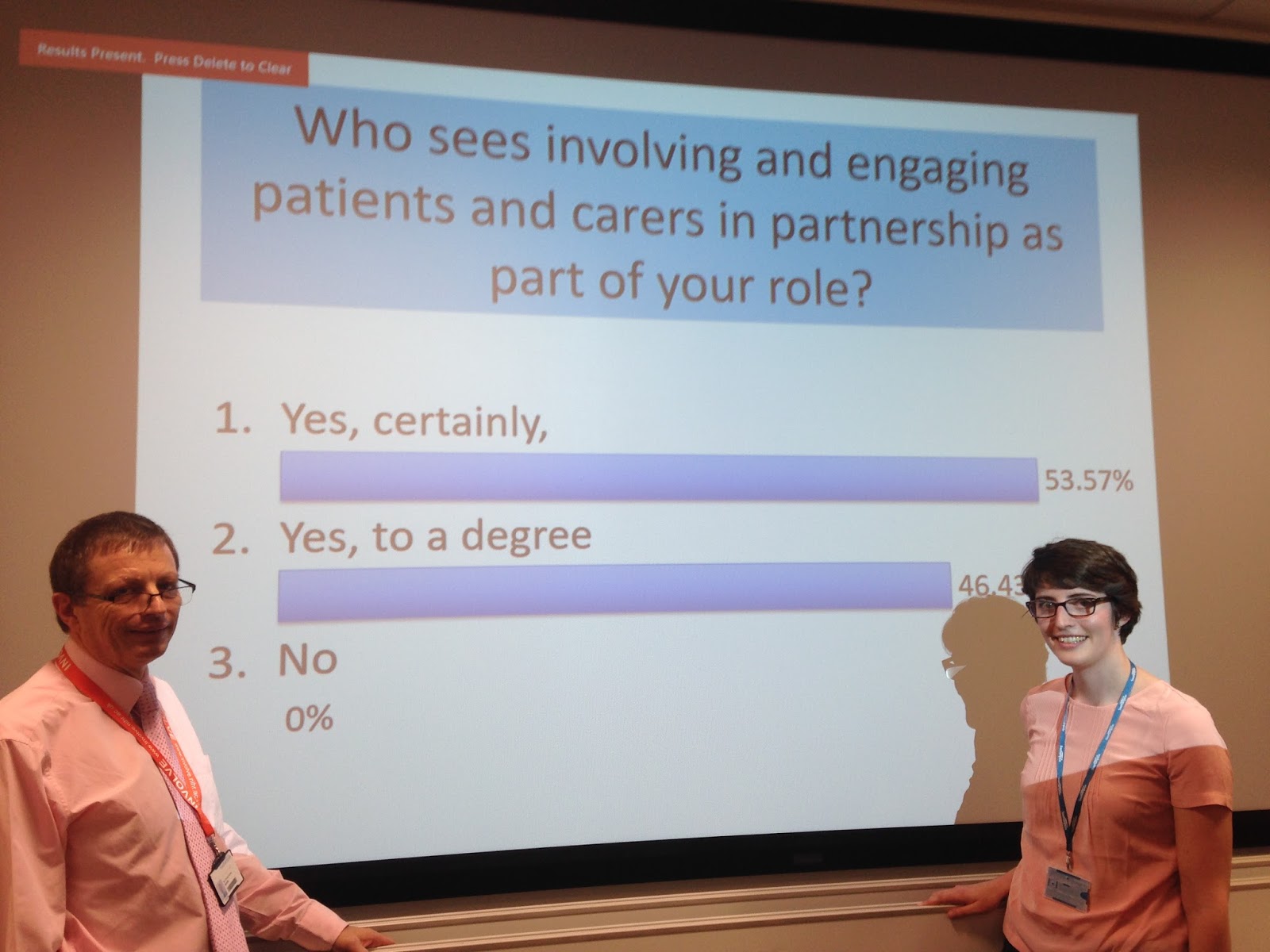


These were students on two different courses at the Faculty of Health Sciences at Southampton University – both post-graduate, qualified health and social care professionals. The sessions were both 1.5 hours, and the first was co-delivered in person, while the second was co-delivered with Trevor Kettle in the room, and me Skyping in. 

The Meetoo App is a platform for real-time polling and discussion that allows students to share their thoughts and reflections, opinions and ask questions.

This blog is a collection of reflections on these experiences. These are twofold:
-       the process of using technology and collaborative teaching as a process to educate
-       the content of the conversation we had with the students.

Underpinning all of this was a strong equal partnership to co-produce the teaching sessions, the content and process between Trevor Kettle and myself – for which I am very grateful. Far from being onerous, this collaboration to coproduce the two teaching sessions required only a preliminary Skype meeting of about an hour and one or two iterations of the PowerPoint slides being shared via email. We had a short reflective debrief afterwards. Trevor’s perspective on it all in included below...

Wednesday, 13 July 2016

Red flags on a Monday morning…

Before 11am on a recent Monday morning, I felt in need of another weekend.

I was chairing a group of patients and carers, who meet to review transformation programmes locally.

In preparation for the meeting, I had spoken to the speaker to check timings and they were clear about what they wanted to discuss and how to do that. I was assured all was ok!

The meeting started well, and the first item on the agenda was introduced – prioritizing areas of a specific programme for in depth co-production engagement work. With 40 mins set for the item on the agenda, the first ten minutes quickly disappeared with an introduction on the process that got the programme to where it was that day, and the questions starting flying in… and my internal chimp mind (the italics below) went into overdrive and concepts of mindfulness went out the window.

Sunday, 19 June 2016

For everything else, there is MasterCard...

Yearly Pre-Paid Prescription Certificate: £104.00
Orthotics: £20
13 day inpatient stay, with MRI, CT and medications: ???
Neck brace and consultation with Orthotist: ???
Two days of tilt table diagnostic tests: ????

A supportive healthcare professional who understands: PRICELESS
Getting back sailing: PRICELESS


Thursday, 21 January 2016

Dear GovNet Advisory Board, This is Groundhog Day, From a Patient.

Since this letter has been published, it has been brought to my attention that there were speakers who had long term health conditions. They were listed in their professional capacity with specific organisations to talk about their organisational experiences rather than from a patients' perspective. Although I can no longer say there were no people with long term conditions at the event, the sentiment of this letter, where the day to day on the ground experience of everyday people with long term conditions was lacking at the event still absolutely stands. I refer to David Gilbert's blog, "We are all patients. Yes and no." to explain this subtle but important difference.
From my perspective, the event still didn't have the opportunity to hear directly from people with long term conditions or carers about what matters to them, and that needs addressing. 
My apologies if I have mislead anyone. 

Dear Rt. Hon Lord Foulkes of Cumnock, Baroness Hilary Armstrong of Hill Top, Lord Archy Kirkwood of Kirkhope, Sir Robert Worcester KBE, DL, Lord Goodlad KCMG PC and Cheryl Gillian MP (GovNet Advisory Board),

As the Advisory Board for GovNet, I wanted to let you know about the Long Term Conditions 2016 conference that took place today that was run by GovNet.

Friday, 19 September 2014

Patient Leaders, Posters and Possibilities....

For me, a "poster" was something like this.... And a "paper" was something like this....


But in the world of academic conferences, they mean something very different. A poster is a very visual and accessible way of presenting a piece of work and a paper is actually a 15 minute talk! The point of these at conferences is to share great work and ideas.

Tuesday, 15 April 2014

The who, what, why, when, where and how of PPI in Meded

I recently had the pleasure of giving the plenary session at the BeSST (Behavioural and Social Scientists Teaching in Medicine) one day conference and AGM. With a brief to explore how patients, carers and members of the public can contribute to medical education, I went down the who, what, why, when, where, how route. As promised, here is a blog to summarise the key points of my plenary session.

Monday, 7 April 2014

Partnerships are possible

I've recently had the privilege of working in a great collaborative partnership with two different professionals: Alf Collins to write an editorial in the BMJ on the Oldham Commission; and Trevor Kettle to co-design and co-deliver workshops on patient and public involvement in healthcare professional education at Southampton University.

I know there is a lot of talk about what it feels like when patients and patient leaders aren't able to work in these kinds of environments, so I wanted to document what is feels like when it does work - to prove it is possible!

Tuesday, 3 December 2013

Integration Pioneers, Personalisation and Self-Management

Unfortunately, travelling is something I find very difficult, and a trigger for my relapses. But fortunately, I have been lucky enough to work with some very accommodating and understanding people such as Don Redding from National Voices. I have been able to contribute and take part in conferences by video, instead of having to travel and risk a relapse to be there in person. If I'm going to be talking about self-management, its important that I self-manage myself too!

I was flattered and delighted when Don Redding asked me to contribute to the NHS Improving Quality Integration Pioneers event, and below is a transcript from my talk that I delivered via video to the event on the 3rd December 2013. This is also available via the National Voices website


Saturday, 26 October 2013

Extreme contrasts: a life in two halves

I have recently commented on Twitter a few times that I felt like I was leading two very different lives, as a patient and as a professional...


Talking to others patients who are working in this area, I don't think I am alone with this feeling. Anyone (in whatever line of work) will feel separation and connection between their personal and prefoessional life, but I think the separation and connection are both more extreme and somehow simultaneous when working in this area.

Monday, 7 October 2013

Personal Reflections on The Future of Health

The two days I spent at Future of Health (and the following few days recovering) have been the hardest, busiest, most challenging, intense, overwhelming and exciting couple of days I have ever had.
Let me explain...

Wednesday, 18 September 2013

Long Term Conditions

I am a passionate advocate for meaningful patient involvement in all aspects of health care.
With conferences as the melting pot of new ideas, it seems only right that contributions from patients themselves are added as essential ingredients into the melting pot. I have commented on this after attending most conferences - where were the patients?
One new idea for involving patients in conferences is being tested at the NHS England/UCL Partners Future of Health conference in October. A Patient Jury, a panel of patients and carers, will provide comment and feedback on the presentations and workshops through the two days. I am excited to have been asked to be part of the Jury and am hopeful that it is going to provide a model for patients and carers to be integrated into the discussions at conferences. I will be posting a follow-up blog on my experience of being on the Patient Jury - to pass my final verdict!